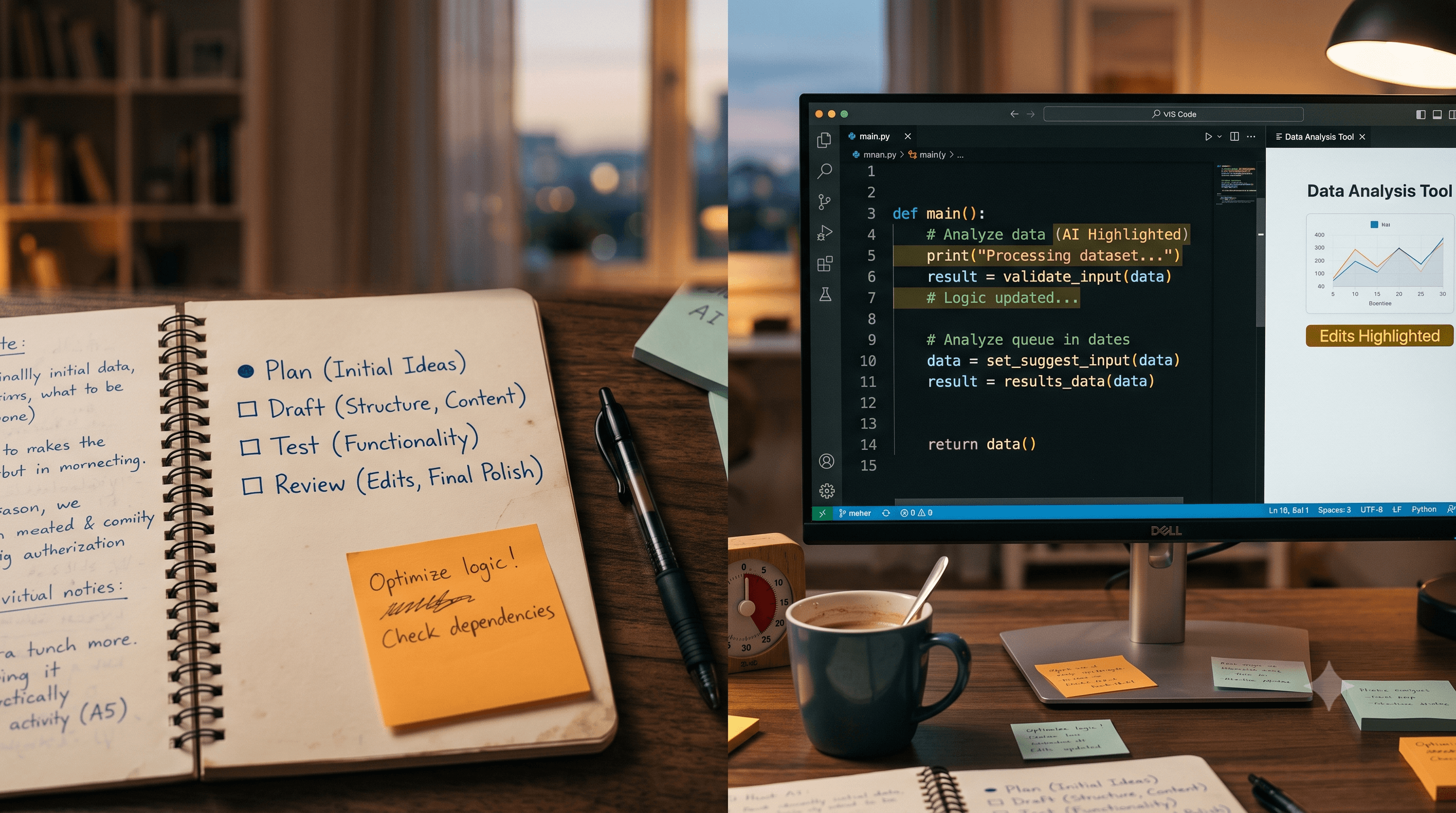
AI coding tools are getting impressive. They can generate pages, fix bugs, explain errors, refactor components, and help people like me build projects that once felt completely out of reach.
That is exciting. It is also exactly why I do not want to treat them like autopilots.
My current AI experiment is simple: use AI coding agents to help me build faster, but never let speed replace review.
Coding Is Only Part of Building
One thing I have learned from building my own websites and apps is that writing code is not the whole project.
There is planning. Testing. Naming things. Checking layouts. Fixing weird spacing. Making sure the button actually goes somewhere useful instead of quietly becoming decorative furniture.
That is why I appreciated a recent comment from DoorDash CEO Tony Xu. He noted that AI can help write code, but engineering productivity depends on much more than code generation alone; teams still need better workflows around how they operate.
That applies beautifully to solo builders too.
The Agent Is Not the Product Manager
AI can suggest what to build next.
It can generate a feature.
It can even create a pull request.
But it does not automatically know the emotional purpose of the product, the needs of the user, or the reason a feature should exist in the first place.
That is where the human builder matters.
If I am building a stress reset app, the goal is not simply to make the screen work. The goal is to help a stressed person feel less overwhelmed and more capable.
That requires psychology, not just code.
What the Research Is Showing
Recent empirical research is beginning to examine how AI coding agents contribute to real software projects. One July 2026 study analyzed agentic pull requests and compared them with human-generated pull requests to better understand how AI-generated contributions change across the software development lifecycle.
Another 2026 study found that autonomous coding agents may produce early development velocity gains in some open-source repositories, but also reported persistent quality risks, including increases in static-analysis warnings and cognitive complexity.
That does not mean we should avoid AI coding tools.
It means we should test them like builders, not worship them like tiny software wizards with Wi-Fi.
My New AI Coding Rule
Here is the rule I am using in my own projects:
Let AI draft. Let the human decide. Let testing tell the truth.
That rule keeps me grounded.
AI can create the first version, suggest an improvement, or help me understand an error message. But before anything becomes part of a real project, I still need to inspect it, test it, and ask whether it actually serves the user.
What I’m Testing Now
In my current building workflow, I want AI to help with specific tasks instead of giving it vague control over the whole project.
That might include:
turning a feature idea into a first draft,
explaining confusing code,
suggesting a cleaner component structure,
identifying possible bugs,
writing test cases,
or helping me create better copy for the user interface.
Those are useful jobs.
But the bigger decisions still belong to the human.
The Psychology of Better Building
Psychology changes how I evaluate AI-generated work.
I am not only asking, “Does this code run?”
I am also asking, “Does this experience make sense to a real person?”
Does it reduce confusion?
Does it support confidence?
Does it make the next step clear?
Does it help someone complete the task without feeling like they need a computer science degree and a snack?
Those questions matter because every app is a behavioral environment. The code creates the structure, but the user lives inside the experience.
What This Does—and Does Not Mean
This does not mean AI coding agents are bad, unsafe, or useless.
It means they are powerful tools that need thoughtful workflows. Current research suggests AI coding agents can contribute meaningfully to software development, but also shows why quality safeguards, review practices, and maintainability checks remain important.
The future I want is not AI replacing builders.
It is AI helping more thoughtful builders create better tools.
Final Thoughts
I love building with AI because it lowers the barrier between an idea and a working prototype.
But the real magic is not that AI can generate code.
The real magic is that I can test an idea faster, learn from it sooner, and improve it with more confidence.
That is why I am treating AI coding agents like assistants, not autopilots.
The assistant can help me move.
But I still want a human hand on the wheel.
Sources
DoorDash CEO Tony Xu discussed why AI-generated code alone is not enough to make engineering teams more productive. (https://www.businessinsider.com/doordash-ceo-tony-xu-ai-coding-not-enough-engineering-productivity-2026-7)
How Do AI Coding Agents Contribute to Software Development? An Empirical Study of Agentic Pull Requests examined how AI-generated pull requests compare with human-generated pull requests across the software development lifecycle. (https://arxiv.org/abs/2607.21832)
AI IDEs or Autonomous Agents? Measuring the Impact of Coding Agents on Software Development found that coding agents may create early velocity gains in some contexts while also introducing quality risks that require safeguards. ](https://arxiv.org/abs/2601.13597)
How AI Coding Agents Modify Code analyzed large-scale AI-generated pull requests and highlighted the need to understand how agentic contributions differ from human contributions. ](https://arxiv.org/abs/2601.17581)
Building with AI does not mean handing over the whole project.
It means learning how to use AI wisely, test what it creates, and keep the human purpose at the center of the build.