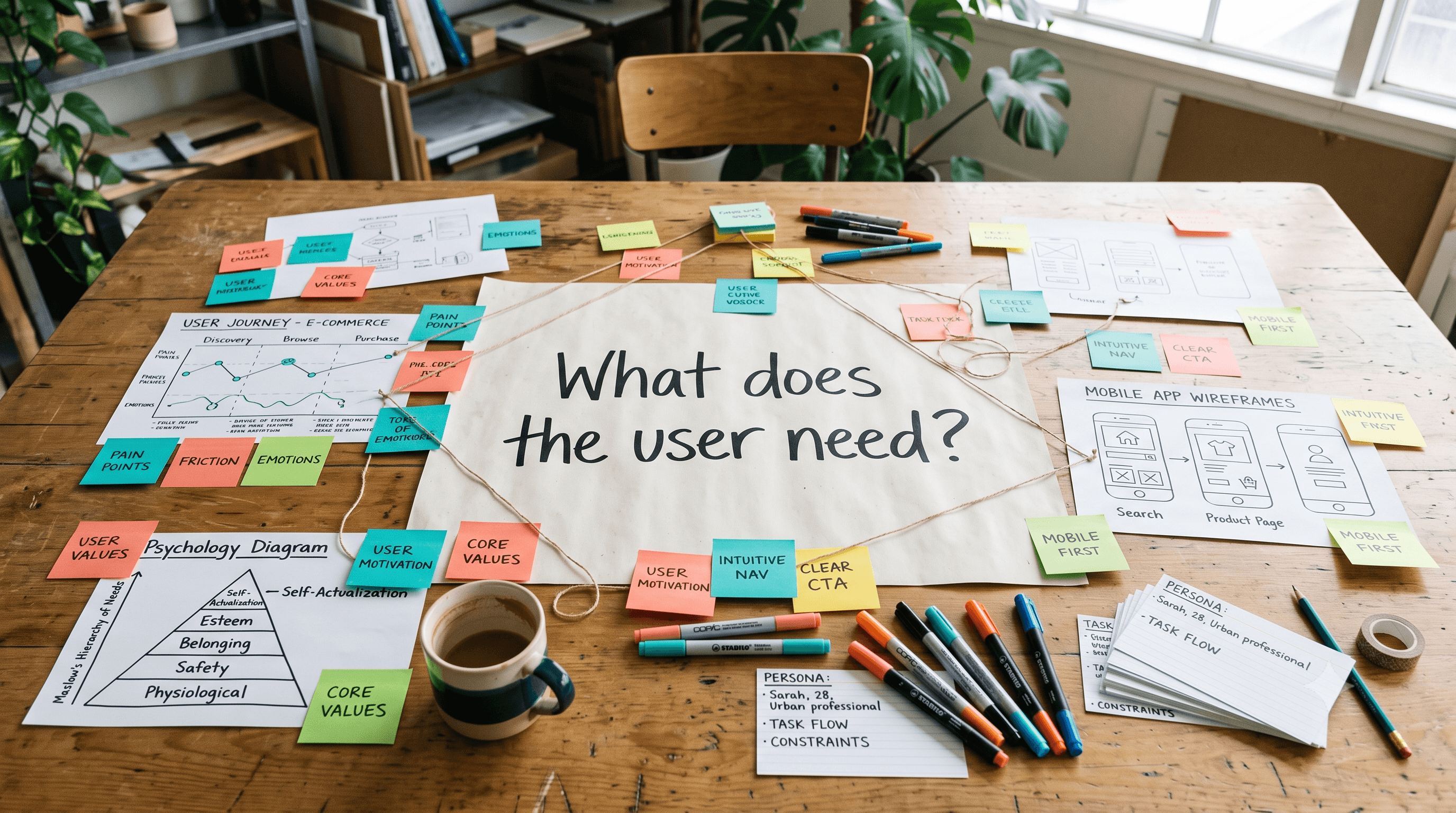
Why Every AI App I Build Starts With One Human Question
When I first started building AI tools, I thought like many new builders do.
I looked at the technology first.
What can this model generate? What features should I add? What workflow looks impressive?
Those questions are interesting.
They just aren't where I start anymore.
The Question That Changed My Process
Today, every project begins with one question:
What does this person need to feel, learn, or accomplish after using this app?
That question sounds simple.
It has completely changed how I design products.
Instead of building around AI, I build around people.
The AI becomes one ingredient—not the entire recipe.
Features Are Easy. Behavior Is Hard.
Adding another chatbot isn't difficult.
Adding another dashboard isn't difficult.
Even generating hundreds of pages of code has become dramatically easier.
The difficult part is designing something that actually improves someone's day.
Will they feel less overwhelmed?
Will they understand something they didn't understand before?
Will they finish the task with more confidence?
Those are behavioral questions.
Psychology helps answer them.
What Research Is Beginning to Show
Across education and AI governance, researchers are increasingly emphasizing that success should not be measured only by technical performance.
A recent framework on AI in education argues that designers should consider cognition, learner agency, emotional well-being, and ethics—not simply efficiency or learning outcomes. The authors suggest that well-designed AI should support thoughtful reasoning rather than encourage passive dependence.
Similarly, the United Nations' Independent International Scientific Panel on AI highlights that AI governance increasingly depends on evidence from psychology, education, health, and the social sciences alongside advances in computer science.
That feels like an important shift.
Every App Is Really Solving a Human Problem
When I built the 30-Day Stress Reset, I wasn't trying to build another wellness app.
I was trying to answer a human question:
How can someone who feels overwhelmed find one small place to begin?
When I work on an AI lesson builder, the question changes:
How can learning become less intimidating?
When I design a psychology tool:
How can someone understand themselves a little better today?
Notice that none of those questions begin with AI.
They begin with people.
My Whiteboard Test
Before I build any feature, I write one sentence on my whiteboard:
"If this feature disappeared tomorrow, would the user actually miss it?"
If the answer is no, it probably doesn't belong.
That tiny exercise has saved me from building features simply because AI makes them possible.
Technology should earn its place.
Psychology Belongs in Product Design
Psychology reminds us that people rarely need more information.
They usually need less friction.
Clearer choices.
Smaller first steps.
Better feedback.
More confidence.
When products are designed around those principles, technology feels supportive instead of overwhelming.
What This Does—and Does Not Mean
This doesn't mean every app has to solve a profound psychological challenge.
Sometimes an app simply saves time.
Sometimes it makes a task easier.
Sometimes it helps organize information.
The important part is beginning with a real human need instead of assuming that another AI feature automatically creates value.
Current discussions in education and AI design increasingly support this idea: thoughtful design, human agency, and meaningful interaction matter just as much as technical capability.
Final Thoughts
AI changes incredibly fast.
Human needs change much more slowly.
That's why I suspect the best AI products of the next decade won't necessarily have the most impressive models.
They'll be the ones that understand people the best.
Every app I build begins with one human question.
So far, that's been the most useful AI prompt I've ever written.
Sources
Independent International Scientific Panel on AI – Preliminary Report (United Nations)
https://www.un.org/independent-international-scientific-panel-ai/en/preliminary-reportAI in Education Beyond Learning Outcomes: Cognition, Agency, Emotion, and Ethics (arXiv)
https://arxiv.org/abs/2602.04598Is AI Killing Critical Thinking in the Classroom? (Financial Times)
https://www.ft.com/content/e2aa33f3-0c66-4a6c-9b7a-ee393b431bee
Every AI project begins with a decision:
Build around technology—or build around people.
I'm choosing people.
Follow along as I document what I'm building, what works, and what I'm learning along the way.